


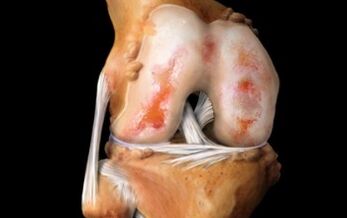
Gonarthrosis or arthrosis of the knee is a severe degenerative-dystrophic pathology of the knee joint, which leads to the destruction of the structure of the cartilage tissue of the joints, which in turn leads to their deformation and loss of function.Pathology often leads to human disability.
Deforming gonarthrosis of the knee occupies a leading place among all arthroses, and if initially only a small part of the joint is affected, in the absence of adequate treatment, when the disease reaches a late stage of development, the entire joint is involved in the pathological process.
The disease most often occurs in people over 40 years old, but in athletes it can also occur at a young age (after serious joint injuries).
Women are most susceptible to joint deformities, but they are common in men and even young children.In order not to aggravate the situation, you need to be able to recognize the first signs of this disease.
Varieties
The classification of gonarthrosis depends on its etiology and localization.Each of the varieties has its own developmental characteristics, which the doctor always takes into account when prescribing treatment.But in the manner of their manifestation they are almost identical.
Depending on the etiology of the disease, there are the following forms of acute arthrosis of the knee joint:
- Primary gonarthrosis.This disease develops without any prerequisites.The risk group includes older people, women and patients with obesity.Gonarthrosis of the knee joint of the primary type can develop for years without manifesting itself.But the earlier it is detected, the better the prognosis for treatment.
- Secondary gonarthrosisKnee pain occurs due to previous injuries, but it can also be a result of various infectious diseases.If damaged joints are treated in a timely manner, the patient has every chance of avoiding this disease.
Depending on the localization, there are types of arthrosis:
- Right-sided gonarthrosis, which develops in the articular tissue of the right knee.It often occurs in athletes, as well as people whose work requires frequent physical activity.
- Left-sided gonarthrosisinvolves the left knee in the pathological process.It occurs in people who exercise professionally, as well as in patients diagnosed with obesity.
- Bilateral osteoarthritishas a destructive effect on the joint tissue of the knees of both legs.This type of disease is considered the most serious, both in terms of symptoms and therapeutic approach.In most cases, this type of knee joint gonarthrosis develops in people of older age and is therefore idiopathic in nature.
Anatomy and pathological changes
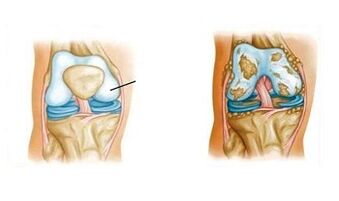
The knee joint is formed from the articular surfaces of the shinbone and femur.In its front part there is the patella, which smoothly slides along the depression between the condyles of the femoral joint during movements.
The femur and tibia, along with the patella, are covered with elastic glial cartilage, which is 5–6 mm thick.It helps reduce friction during physical activity and provides a shock-absorbing function in the event of a fall.
Pathological changes in the joints: gradual disorders
In the first stage of development of gonarthrosis of the knee joint, blood circulation is primarily affected.The small intraosseous vessels that supply blood to the hyaline joint are disrupted, which leads to gradual drying out of its surface.It becomes less elastic and cracks begin to form on its surface.
This results in these cartilages touching each other instead of sliding smoothly.Gradually, inflammation begins to develop, and diseased cartilages, shifting easily, prevent each other from fully performing their functions.Due to the formation of a large number of microcracks in the area of the tissues that make up the cartilage, they gradually lose their shock-absorbing properties.
In the second phase of the progression of gonarthrosis, compensatory changes begin in the bone area.Under the influence of increased loads, the articular platform begins to gradually flatten, which leads to compaction of the subchondral zone (the area of the bone located under the cartilage).
The articular surfaces along the edges begin to grow over with bony processes, which look like sharp points on the X-ray.
When the lubricating fluid in the joints becomes thicker, it loses much of its function.This leads to accelerated cartilage breakdown.Because of this, it looks like a thin thread on an X-ray or becomes completely invisible.
If this was noticed, it means that the disease is smoothly (or quickly - it all depends on the situation) moving into the 3rd phase of development.
In the third stage of gonarthrosis of the knee joint, noticeable deformation of the bones occurs.They appear to be squeezed into each other, resulting in reduced mobility of the joints.The cartilage tissue is almost completely exhausted.
Causes and predisposing factors

The causes of osteoarthritis of the knee joint are not isolated - the doctor often identifies several factors at the same time that led to the development of the disease.
The most common and common reasons are:
- previous joint injuries (moderate or severe);
- Ankle fractures, especially if there is intra-articular damage;
- Violation of the integrity of the meniscal structure;
- tears or complete tears of ligaments;
- excessive strain on the knee joints.
Acute osteoarthritis of the knee joint is directly related to a person's age.It has been found that people over 40 are most susceptible to this, as during this period the flexibility of the cartilage decreases and the synovial fluid gradually “dries out”.
To delay this moment, patients are recommended to play sports, but physical activity should be moderate and not lead to general discomfort.
Being overweight is also one of the predisposing factors for the development of gonarthrosis.The fact is that excess body weight places additional stress on bones and joints, which can only negatively affect their health.
The fact which leg is put under greater strain plays an important role.For example, if your “support” is your left leg, there is a high probability that you will develop left-sided gonarthrosis.
In obesity, the constant pressure on the joints leads to microtrauma and rupture of small blood vessels.Meniscus or ligament tears, which are considered a serious manifestation of joint injuries, are also possible.
This disease is extremely difficult for patients with pronounced varicose vein symptoms.In this case, the patient is recommended to visit a phlebologist.
Also at high risk of developing this pathology are people who:
- previously suffered from various types of arthritis;
- have an unfavorable heredity;
- have problems with the ligaments;
- suffer from metabolic disorders;
- suffered traumatic brain injuries;
- injured in a traffic accident;
- had spinal injuries.
Many of these factors are often closely related to each other.An accurate determination of the cause helps to make an accurate diagnosis and prescribe the patient the correct and effective treatment for arthrosis of the knee joint.
Clinical manifestations
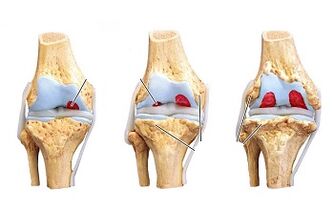
The symptoms of gonarthrosis do not appear immediately, but appear gradually depending on the stage of the disease.For this reason, the clinical picture must be viewed step by step.
First stage
At the initial stage of the development of the disease, patients complain of mild pain in the knee area, which increases with physical activity.They become particularly intense when descending and ascending stairs.
In addition to the pain, the patient feels a certain stiffness of movement, a “tightening” in the joint area.It can be felt in the back of the knee area and disappears when the knee muscles relax.
Another characteristic symptom is the so-called “starting pain syndrome”.It develops during the patient's first steps.As the knees get used to the load, this anomaly disappears without a trace.
Second stage
At this time, the symptoms of arthrosis of the knee joint become more intense and noticeable.The pain increases and causes significant difficulty and discomfort when walking.The pain syndrome disappears after a long rest, but becomes noticeable again during intensive physical activity.
Joint inflammation leads to swelling of the knee, which is visible to the naked eye.There is a strong, unpleasant crunching noise when walking.Movements become more difficult and restricted.
Stage three
The pain becomes very severe and the patient cannot do without painkillers.A person finds it difficult to bend his knee, he feels stiffness in the movements of the joint.It deforms and increases in size.In severe cases, the patient cannot move without additional support.
All these signs of arthrosis of the knee joint should not be ignored by the patient.The disease can put a person in a hospital bed for a long time and sometimes cause disability.
Which doctor treats gonarthrosis of the knee joint?
To diagnose and treat knee gonarthrosis, you must consult an orthopedic traumatologist.If surgery is necessary, the help of a surgeon may be required.
Diagnostic measures
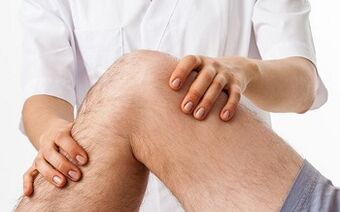
To determine the cause of the disease, a comprehensive examination of the patient is extremely important.
The diagnostic scheme consists of several stages:
- Visual examination by an orthopedist and anamnesis.The doctor determines whether the patient has symptoms of acute arthrosis of the knee joint, palpates the affected area of the leg, measures the bone and performs angiometry - a test that allows assessing the mobility of the joint from different angles.
- Clinical blood test to assess ESR.
- Biochemistry of the blood.
- Examination of urine and blood for the content of fibrinogen, urea and other substances.
- Radiography is one of the most common examination methods for osteoarthritis.However, in the early stages the image does not show any changes - these are only noticeable in the later stages of development.The x-ray shows a narrowing of the joint space, sclerotic changes in the cartilage area, damage to the bone tissue and salt deposits.
- Ultrasound is the most informative diagnostic procedure.However, complete examination results can be obtained if ultrasound is performed together with an X-ray.
- MRI allows you to thoroughly examine all layers of articular, cartilage and bone tissue and detect the first dystrophic changes in the early stages of arthrosis development.However, MRI has one major disadvantage: the procedure is quite expensive.But its high accuracy helps make a 99.9% accurate diagnosis.
Treatment
The treatment of acute osteoarthritis of the knee and its diagnosis require an integrated approach.However, drug therapy is required first, as the diseased joint can become inflamed at any time.
Drug treatment
How to treat gonarthrosis of the knee joint with the help of medicines and which drugs to choose?Only a traumatologist can give you information about this.The treatment regimen often includes drugs from the following groups:
- Nonsteroidal anti-inflammatory drugs COX-1 or 2. The first group can cause serious damage to the gastrointestinal tract and therefore should not be used for a long period of time.This does not apply to drugs in the COX-2 group, which are more gentle.They are administered intramuscularly or intravenously.
- Hormonal medications are also used to treat arthrosis of the knee joint.They help relieve inflammation and eliminate swelling in the knee.Its use is recommended when synovitis occurs (an inflammatory process in the area of the joint lining).
- Treatment with chondroprotectors.
- Application of ointments, gels, creams.They improve blood circulation, warm, relieve swelling and inflammation.
Method one
How to cure arthrosis of the knee joint using this method?The main elements of the treatment regimen are:
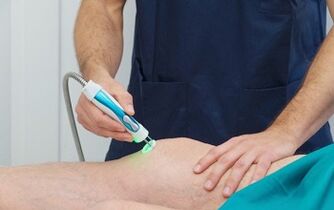
- taking medications (NSAIDs, chondroprotectors, painkillers, ointments, creams, gels);
- light physiotherapy;
- manual therapy;
- physiotherapy;
- warm anti-inflammatory compresses with medicinal solutions.
In addition, according to the famous rheumatologist, diet plays an important role in osteoarthritis.Through a properly balanced diet and the use of all of the above methods, you can achieve amazing therapeutic results in the shortest possible time.
Method two
This method is often used to treat arthrosis of the knee joint, as well as other joint diseases.
The development of the famous doctor is based on the use of:
- medication;
- surgical intervention;
- following a diet that removes excess fluid from the body;
- exercise therapy;
- Physiotherapy.
The doctor also recommends swimming more in the pool, visiting the sauna and getting a massage.This will help improve the patient's health, especially if the disease has been ignored and untreated for a long time.
Treatment with the third method
When treating gonarthrosis of the knee joint with this method, dynamic loads are completely eliminated, as they can significantly accelerate the deformation process.Physical exercises should be done slowly and with low amplitude.
Example: Sit astride a chair, i.e. with your face backwards.Spread your legs wide apart, but don't let them touch the floor.Alternately swing each leg slightly.Do the exercise until you feel slightly tired.The number of approaches depends on the patient's well-being.
Surgical intervention
How do you treat advanced osteoarthritis of the knee joints?In this case, there is only one way out - surgery.There are several types of operations performed for arthrosis of the knee joints:
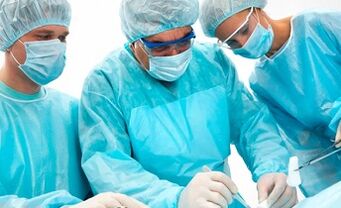
- Removal of deformed cartilage tissue and diseased joints (arthrodesis).This happens extremely rarely.
- Removal of damaged cartilage tissue without removing the joint.This procedure is called arthroscopic debridement.It is carried out using a special device – an arthroscope.The procedure is simple, but the effect does not last longer than 3 years.
- Sawing and securing the diseased joint at a different angle.This method is called periarticular osteotomy.The technique is quite complex, but allows you to forget about the pathology for 3-5 years.
Surgical intervention is rarely resorted to, and only when there is no method that will cure the disease at least for 1-2 years.In the early stages of the disease, surgery is almost never performed.
Endoprosthetics
Endoprosthesis replacement is considered the most common method of treating gonarthrosis.This is an operation that allows you to completely preserve the mobility of the diseased knee.However, despite its effectiveness, this technique requires long-term rehabilitation.In addition, it can have serious consequences.
Instead of the “real” one, the patient is implanted with an artificial joint that can last 20 years.Of course, it depends on the material from which it is made.The procedure is not cheap, but very effective, which is why it is particularly popular.
Therapeutic exercise
Depending on the stage of the disease, the doctor will prescribe exercise therapy.However, the principles for carrying out the exercises are the same in all cases:
- Avoiding heavy strain on the knee joint;
- sudden and forced movements are prohibited;
- Do not perform exercises that require full weight bearing on the painful joint.
Permitted exercises:
- slight trembling of the legs when kneeling on a blanket spread on the floor;
- careful movements on the knees in the same position;
- In the same position, straighten your legs one after the other, trying not to lift your heels off the floor.Then bend them again and avoid sudden movements.
Such exercises in combination with drug treatment and physiotherapy produce excellent results.
Physiotherapy
All physiotherapeutic procedures are prescribed for gonarthrosis that is in remission.The most effective methods include:
- electrophoresis with medical solutions;
- magnetic field therapy;
- ultrasound therapy;
- microwave treatment;
- paraffin therapy;
- baths with radon or hydrogen sulfide;
- Sludge treatment.
To prevent a recurrence of the disease, physiotherapy courses must be completed at least 2 times a year.This will help prolong the remission period.
massage
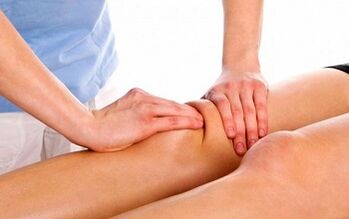
A knee massage is performed to improve blood circulation.It is carried out along the lymph flow in the direction from the peripheral area to the central zone.The popliteal fossa is not involved in this process.
Often, in addition to massage, manual therapy sessions are also carried out, aimed at gradually stretching the painful joint.Such interventions stabilize the patient's condition, but can only be carried out by a specialist.
Is gonarthrosis completely curable?
Is it possible to completely cure osteoarthritis of the knee joint?Perhaps no one, not even the most experienced traumatologist, can give an unequivocal answer to this question.It all depends on the severity of the disease.If you carry out therapy in the first stages of development, you can stop further deformation of the joint.
However, if pathology is detected at the final stage, even surgical intervention does not guarantee the complete disappearance of unpleasant symptoms.The operation only helps with healing for a few years, after which the disease can make itself felt again.
Prevention
To prevent gonarthrosis, it is necessary:
- avoid knee injuries;
- Constantly perform physical exercises (squats, running, raising and lowering legs);
- enrich the diet with foods containing many vitamins;
- Limit consumption of salt, hot spices, fried, smoked and sweets;
- maintaining normal physical condition;
- Consult a doctor immediately if you suffer the slightest knee injury.
- preventive use of chondroprotectors after reaching the age of 35;
- Drink the daily amount of water (2 l).
If you follow these simple recommendations, you will reliably protect yourself from osteoarthritis of the knee joint as well as other diseases that can have a lasting impact on your quality of life.